




Description
Reduce Hard Water and Limescale
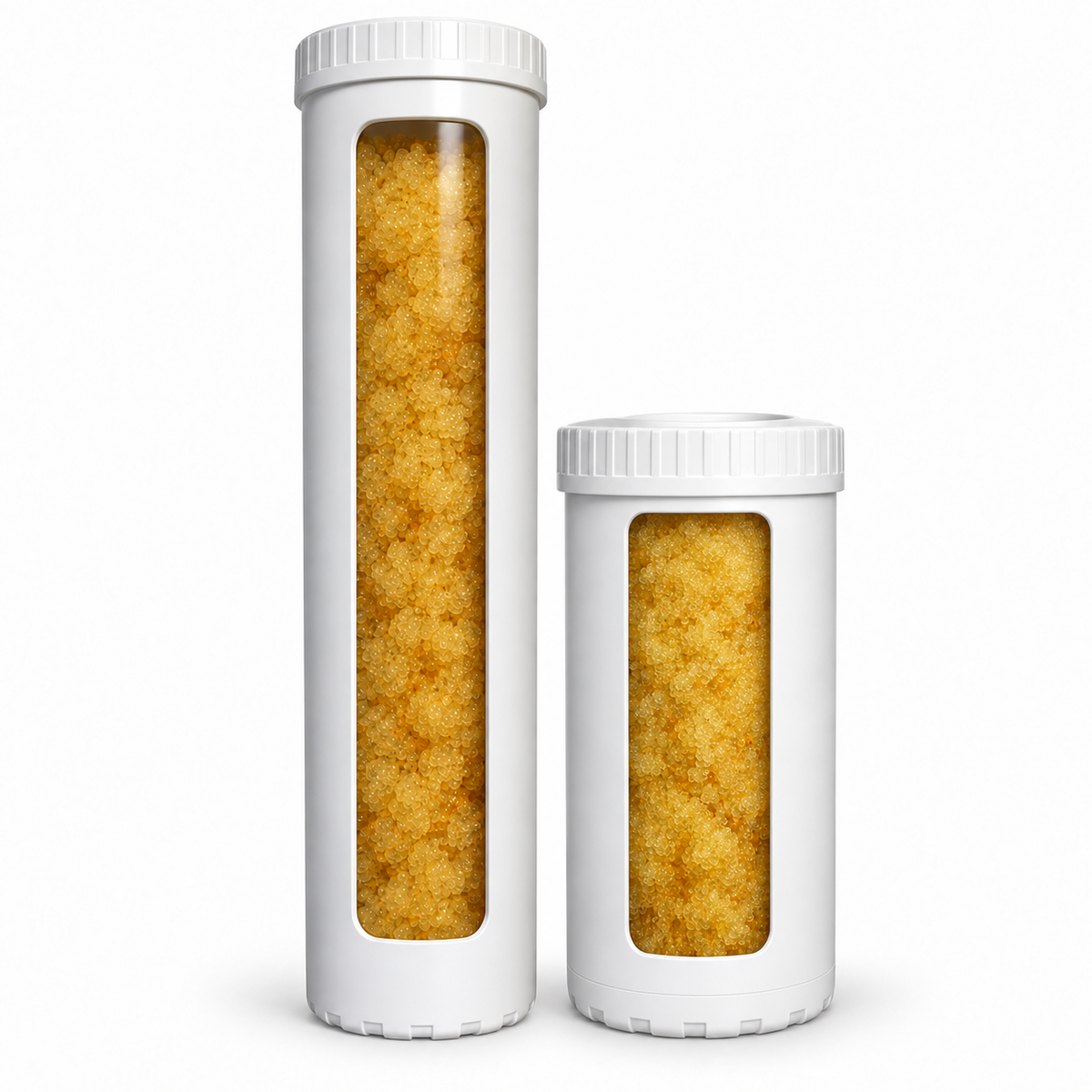
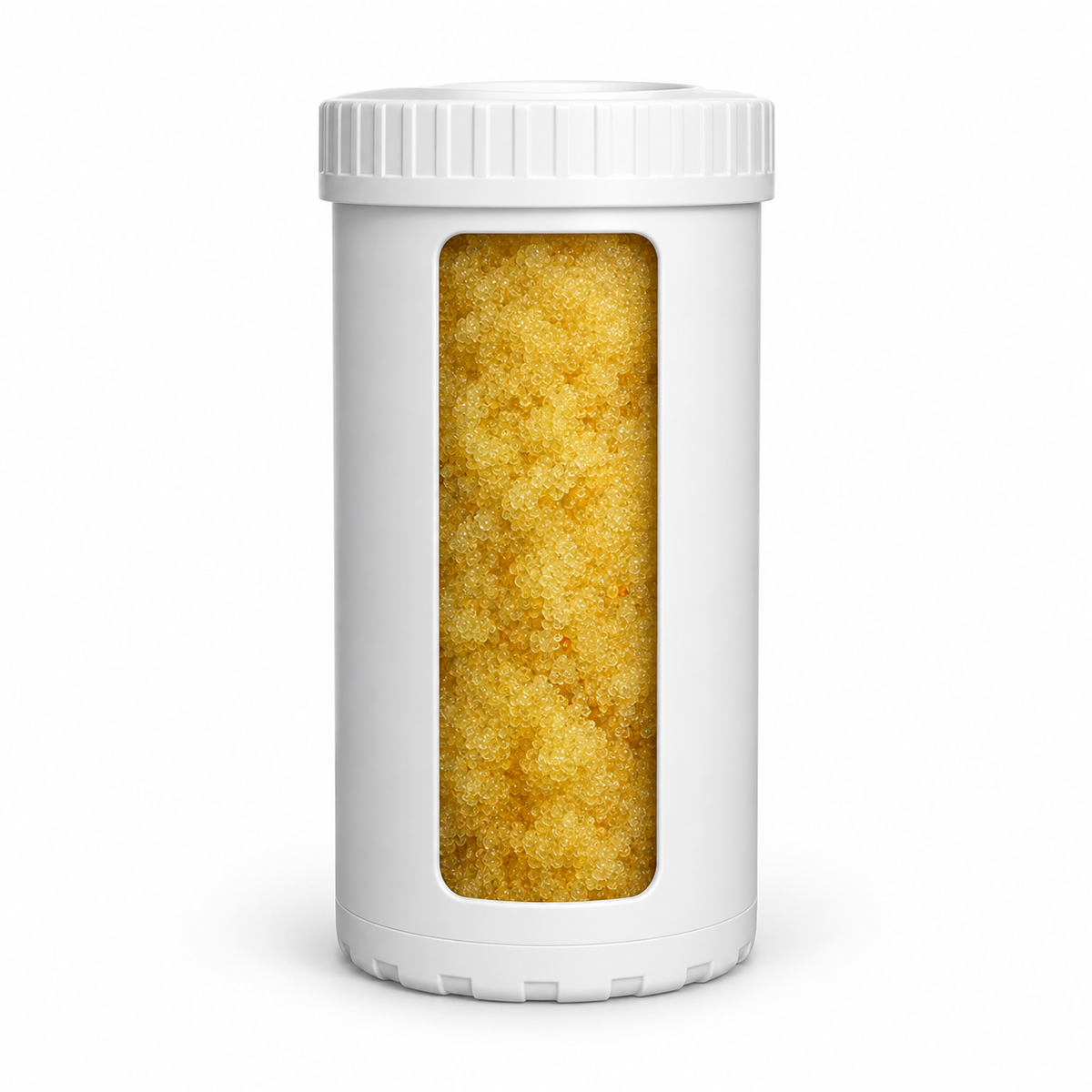
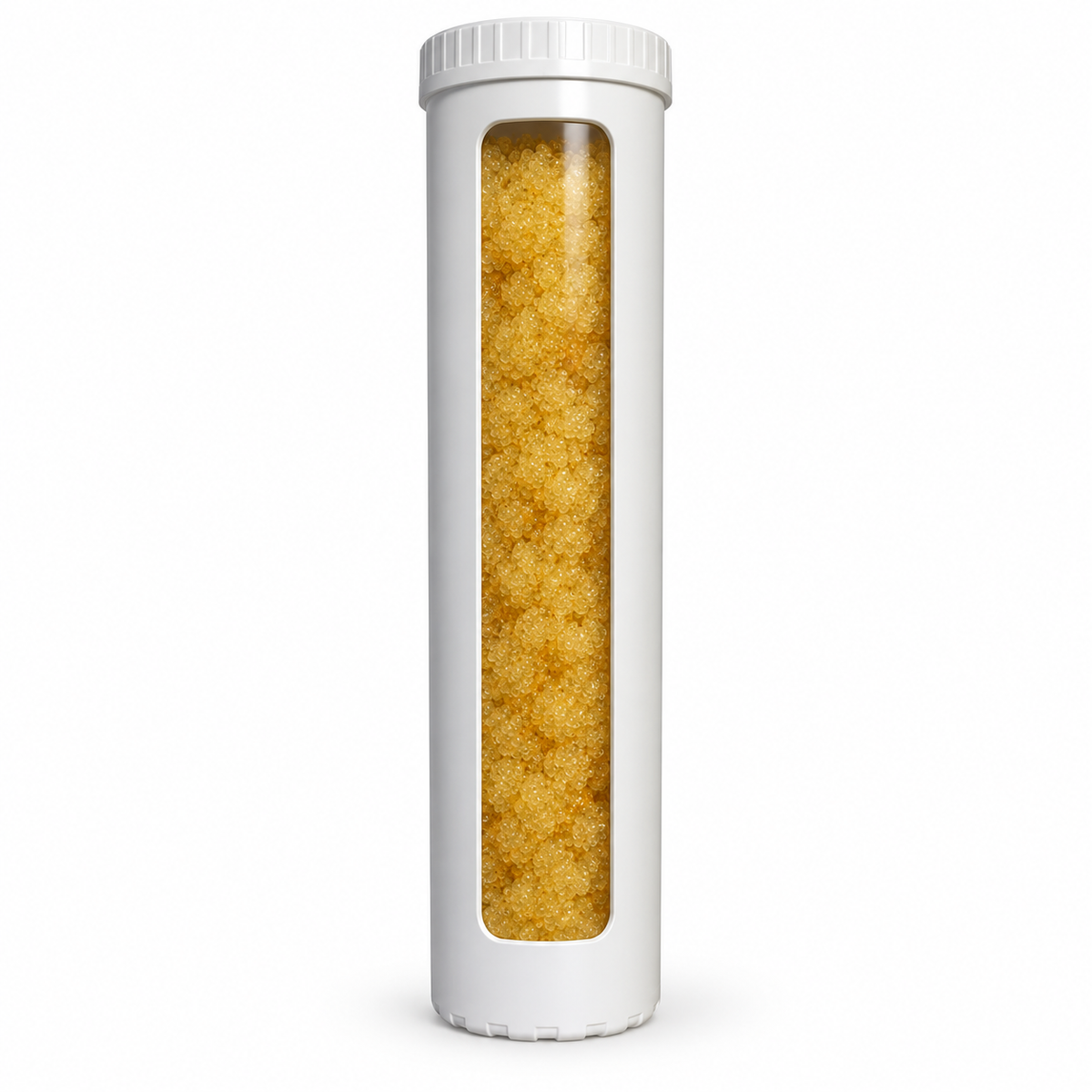
These reusable Jumbo Water Softening Cartridges are filled with Aquatrol CAT100E premium cation exchange resin and are designed to reduce the calcium and magnesium responsible for hard water and limescale.
Available in 10" Jumbo (WS10J) and 20" Jumbo (WS20J) sizes.
CAT100E is supplied in the sodium (Na+) form and is specifically designed for applications including the softening of hard water.
Unlike disposable scale-control cartridges, the CAT100E resin can be regenerated using ordinary sodium chloride salt and reused.
Available Sizes
| Model | Cartridge Size | CAT100E Resin | Housing Required |
|---|---|---|---|
| WS10J | 10" × 4.5" Jumbo | 2 litres | 10" Jumbo Housing |
| WS20J | 20" × 4.5" Jumbo | 4 litres | 20" Jumbo Housing |
The WS20J contains twice the resin volume of the WS10J, giving substantially longer service between regenerations under the same water conditions.
How Water Softening Works
CAT100E is a strong-acid cation exchange resin supplied in the sodium form.
As hard water passes through the cartridge, calcium and magnesium ions are exchanged for sodium ions. This reduces the hardness minerals responsible for:
- White scale on taps, shower screens and appliances
- Scale formation in hot-water equipment
- Poor soap lather
- Mineral spotting
Once the resin becomes exhausted, it can be regenerated using a sodium chloride brine solution.
Flow Rate is Important
For best performance, water needs to pass through the resin at an appropriate rate.
Recommended operating flow through either cartridge: approximately 2–6 LPM.
Aquatrol specifies an operating velocity for CAT100E of 10–45 metres/hour. For a Jumbo cartridge of this diameter, approximately 2–6 LPM is a practical operating range.
Very low flow rates can encourage preferential flow paths or channeling through the resin bed, meaning some of the resin may not be fully utilised.
Excessive flow rates reduce contact time between the water and resin and can result in hardness leakage and reduced effective softening capacity.
The WS20J provides more capacity rather than substantially higher flow. Because both cartridges have approximately the same diameter, their recommended service flow is similar.
For sustained high-flow whole-house applications, a conventional vessel-style automatic water softener may be more suitable.
Does It Remove Chlorine?
No. CAT100E is a water-softening ion exchange resin and is not designed to remove chlorine, sediment, taste or odour.
Where chlorine is present, we recommend installing an activated carbon cartridge before the softening cartridge.
A typical arrangement would be:
Sediment Filter → Carbon Filter → Water Softening Cartridge
Estimating Cartridge Life
If you retain your existing nominal capacity ratings:
| Model | Nominal Hardness Capacity* |
|---|---|
| WS10J | 38,475 mg |
| WS20J | 76,950 mg |
To estimate the volume of water that can be softened:
Cartridge capacity ÷ incoming water hardness in mg/L as CaCO₃ = approximate litres treated
For example, with incoming hardness of 150 mg/L as CaCO₃:
WS10J
38,475 ÷ 150 = approximately 256 litres
WS20J
76,950 ÷ 150 = approximately 513 litres
Actual capacity will vary according to incoming hardness, TDS, flow rate, water chemistry and the degree of regeneration achieved.
*Nominal cartridge capacities should only be used if these figures are supported by your supplier or existing cartridge specification.
Regenerating the Resin
Aquatrol specifies a 30–60 minute regenerant contact time for CAT100E.
For these cartridges we recommend a 60-minute manual soak regeneration.
What You Need
| WS10J | WS20J | |
|---|---|---|
| CAT100E resin | 2 L | 4 L |
| Non-iodised sodium chloride | 360 g | 720 g |
| Water for brine | 1.4 L | 2.8 L |
| Water for initial resin rinse | 1.6 L | 3.2 L |
| Total water required | 3 L | 6 L |
You will also need:
- A clean bucket
- A strong food-safe or heavy-duty plastic bag
- Clean softened or low-hardness water where possible
Recommended Salt
Use plain non-iodised sodium chloride (NaCl).
Fine additive-free non-iodised salt is preferred because it dissolves easily.
Iodised table salt will still regenerate the resin if necessary, but non-iodised salt is preferred for regular regeneration.
Do not use:
- Epsom salt
- Potassium/lower-sodium table salt blends unless specifically intended for ion exchange
- Seasoned or flavoured salt
Regeneration Instructions
1. Prepare the strong brine
For the WS10J, dissolve:
360 g salt in approximately 1.4 litres water
For the WS20J, dissolve:
720 g salt in approximately 2.8 litres water
This produces an approximately 20% NaCl brine solution.
Stir until the salt is dissolved.
2. Remove the cartridge
Turn off the water supply, release pressure from the filter housing and remove the cartridge.
3. Remove the resin
Remove the top cap from the cartridge.
Place the heavy-duty plastic bag inside a clean bucket and carefully pour the CAT100E resin into the bag.
Use a small amount of the prepared brine to rinse any remaining resin from inside the cartridge into the bag.
4. Add the brine
Pour the remaining brine into the bag.
Gently move the resin around to ensure that all of the media is thoroughly wetted and exposed to the brine.
5. Soak for 60 minutes
Allow the resin to soak for 60 minutes.
Gently agitate the bag several times during the soak to improve contact between the resin and brine.
6. Drain the brine
After 60 minutes, carefully drain the used brine from the bag.
Avoid disposing concentrated salt water onto lawns, gardens or plants.
7. Rinse the resin
Add:
- WS10J: approximately 1.6 litres clean water
- WS20J: approximately 3.2 litres clean water
Gently mix through the resin and drain.
8. Refill the cartridge
Carefully return the resin to the cartridge and securely refit the cap.
9. Reinstall and flush
Reinstall the cartridge into the filter housing and slowly restore the water supply.
Flush thoroughly to waste at a low flow rate until there is no salty taste remaining before using the water normally.
I would remove your existing “run for 1–2 minutes” instruction. The amount of flushing required will vary, so “until no salty taste remains” is safer than giving an artificially short fixed time.